
While so much of public relations and comms is about trying to maximise reach to target audiences in order to maximise the resulting Outcomes desired, it’s easy to forget that local news and local media still play an important role as channels.
A few of the many statistics around local news in Ofcom’s recently-released News Report 2026 show why it shouldn’t be ignored.
Local News has high reach and is valued
“Almost all adults (95%) access local news and information.”
“Local news is valued as it helps people understand what is happening in their immediate communities and is seen as personally relevant particularly in tight-knit communities.”
It’s “rated as one of the top three most important types of news (71%), behind UK news (78%) and breaking news (77%).”
What people are reading
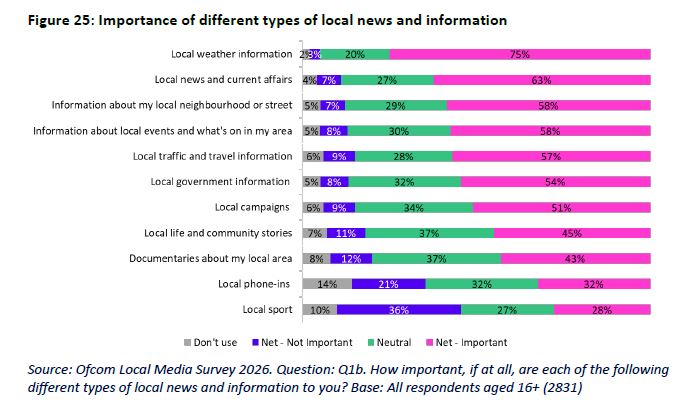
Source and copyright: Ofcom.
Local weather, news and current affairs, information about their neighbourhood or street, local events, what’s on, local traffic and travel are still read regularly because they have a very direct impact on people’s lives, which is why they’re valued so highly.
Where people are getting their Local News
“All audiences, including those in older age groups, are using a mix of traditional and online ways to access news.”
So while the circulation and readerships of local daily and weekly print newspapers are declining, they are part of an ecosystem still relevant to all groups and still being used, mainly now through online and digital platforms.
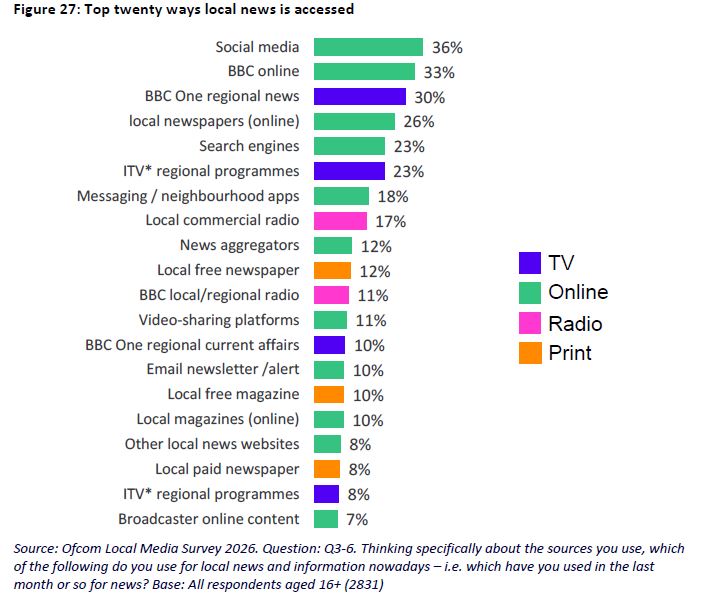
Source and copyright: Ofcom.
“In 2026, the most common [channel] was through word of mouth (54%), [81% use online], social media (48%) and television (42%).”
Local newspapers’ online presence is the fifth biggest local news channel (26%), local commercial radio ninth (17%), local free newspapers 11th (12%), BBC local radio 12th (11%), local free magazines (10%), local magazines’ are read online by 10%, other local news websites gain 8%, and local paid newspapers 8%.
When grouped together, “any online way of accessing news, including social media, was used by 81% of adults for local news and information.”
Local media are still important
The importance of local media in creating local news content which is then distributed on other channels is highlighted by the report, specifically in where ‘online intermediaries’ gain their local news content from. The report defines them as “Services that facilitate the distribution of content from news publishers rather than producing and distributing their own news content. These include search engines, news aggregators, social media and video-sharing platforms.”
“Among online intermediary brands, Google (dominated by Google Search) has the highest reach for news content (60%), followed by Meta (51%), which includes Facebook (39%), Instagram (26%) and WhatsApp (21%).”
“Among those who say they are using any of these online intermediaries for news, many will be accessing news provided by traditional news organisations on these platforms but have indicated that the place they get their news is through the intermediaries.”
So the local news sent to and published by local media is picked up by these online intermediaries and distributed to another 59% of people 16+ beyond local media’s print, online and digital channels. Meaning their content’s total reach is much higher.
Where local newspapers still play a key role
“Traditional news platforms generally score higher on perceptions of trustworthiness, accuracy and impartiality compared with online platforms.”
So if you’re communicating something where message acceptance and changing opinion is important, getting local print coverage is still important.
If you want to get the most out of using local news via local media, you need to use a PR professional with up-to-date knowledge of the local media you need to use. I have ongoing experience of those in Angus, Fife and Tayside. Get in touch if you have a story you want to discuss.